By Grant, owner-operator · June 10, 2026 · 8 min read
Your Stucco, Wood, and Roof Can't Take a Pressure Washer
If you are about to rent a pressure washer in Goleta for a weekend of exterior cleaning, here is the short version before you load it into the truck: keep it off your stucco, your wood, and your roof. Those three surfaces make up most of your house, and they are exactly the ones a pressure washer damages fastest. A rented machine is a great tool for a concrete driveway and a genuinely risky one the moment you point it at the walls or up at the eaves. Every week somewhere on the South Coast, a homeowner rents a 3,000 PSI machine, gets the driveway looking sharp, then swings it over to the stucco because it is right there, and turns a fifty-dollar rental into a repair bill.
The reason is simple. Pressure washing cleans with force, and these three surfaces are either too soft, too porous, or too fragile to take it. The film and streaking you are trying to remove are biological, algae and mildew fed by the marine layer, and force is the wrong lever for a biological problem. Let us go through the three surfaces you will regret blasting, why each one fails, and what actually works instead.
Surface One: Your Stucco
Stucco is the first surface to keep the wand away from, and it is the one Goleta has the most of. Nearly every home here wears a stucco or plaster exterior, and it is porous by design. Hit it with a pressure washer and two things happen at once. The force cracks and etches the finish coat, leaving a rough, pitted patch that never quite matches the wall around it, and the water gets driven straight through the surface into the wall cavity behind it, where it has no fast way back out.
That trapped moisture is the part you don't see until later. It feeds mold inside the wall and can sit against the framing long enough to rot it, and by the time a stain bleeds through on the inside, the damage is done and the repair is a wall-opening job, not a touch-up. A hairline crack you put in the stucco also becomes a moisture entry point for every marine-layer morning that follows. The wall was doing its job of shedding water until the pressure washer compromised it.
Stucco is a soft-wash surface, full stop. A low-pressure application with a cleaning solution kills the algae and mildew in the pores and rinses it clean without cracking the finish or forcing water behind it. That is the method that clears the green-black film off a shaded Goleta wall and leaves the stucco intact.
Surface Two: Wood Fences, Decks, and Trim
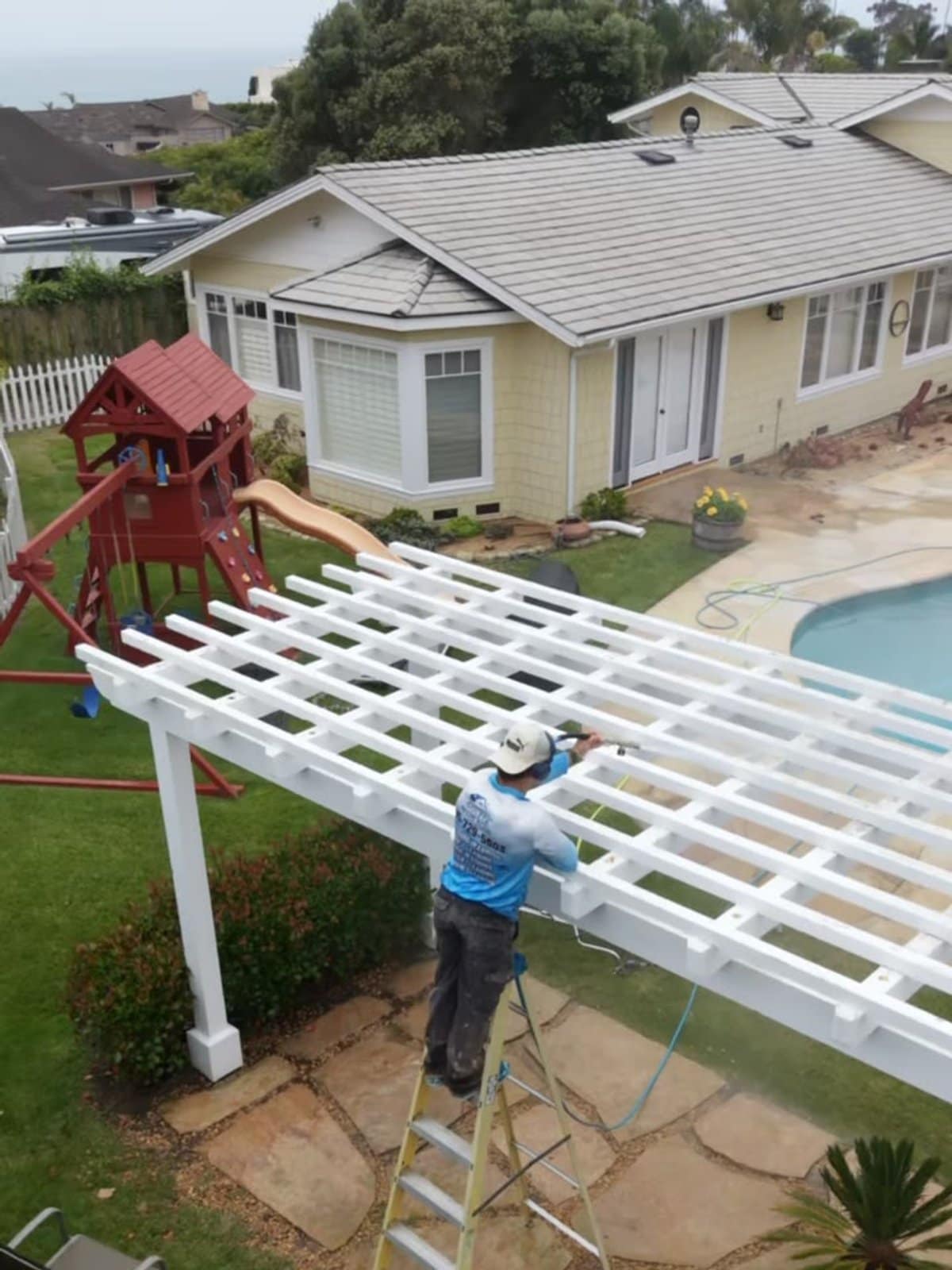
Wood is the second surface, and it covers more of your property than you might think: fences, deck boards, railings, pergolas, gates, and painted trim. Wood is soft and it has a grain, and a pressure washer works along that grain like a chisel. It tears out the soft fibers between the harder grain lines and leaves the surface furred and splintered, rougher than before you started.
A furred deck board is not just ugly, it sheds water worse and holds dirt faster, so the cleaning that was supposed to renew it actually shortens its life. On painted or stained trim and fences, the pressure strips the finish off in a single pass, and now you have a raw section that needs sanding and refinishing on top of everything else. People reach for high pressure on a gray, weathered fence hoping to bring it back, and instead they carve it up.
Wood gets cleaned at low pressure with the right solution, which lifts the gray oxidation and the mildew without gouging the grain. It comes out even and smooth, ready to seal or stain, instead of torn open. The force that felt like it was doing more was doing damage.
Surface Three: Your Roof
Your roof is the third surface, and it is the most expensive mistake of the three. Goleta roofs are mostly composition shingle and Spanish clay or concrete tile, and a pressure washer ruins both in its own way. On asphalt shingle, the machine blasts off the ceramic-coated granules that are the shingle's entire defense against the sun. You will watch them wash into the gutter by the thousands, and once they are gone the asphalt underneath dries, cracks, and fails years early.
On tile, the damage is water and cracks. High pressure drives water up under the tiles and past the underlayment, which is the actual waterproof layer of the roof, so the leak shows up in the first winter storm and nobody connects it to the summer cleaning. And a close jet chips and cracks brittle old terracotta, which is expensive and hard to match. Most shingle manufacturers also specifically warn against pressure washing, so blasting the roof can void the warranty on top of the damage.
A roof is never a pressure-washing job here. It is a soft wash every time, which kills the Gloeocapsa magma algae and the moss with a solution at low pressure and leaves the granules, the tile, and the underlayment exactly where they belong. If the streaks on your roof are what got you thinking about renting a machine, that is the surface to hand off, not to blast.
What a Rented Machine Is Actually Good For
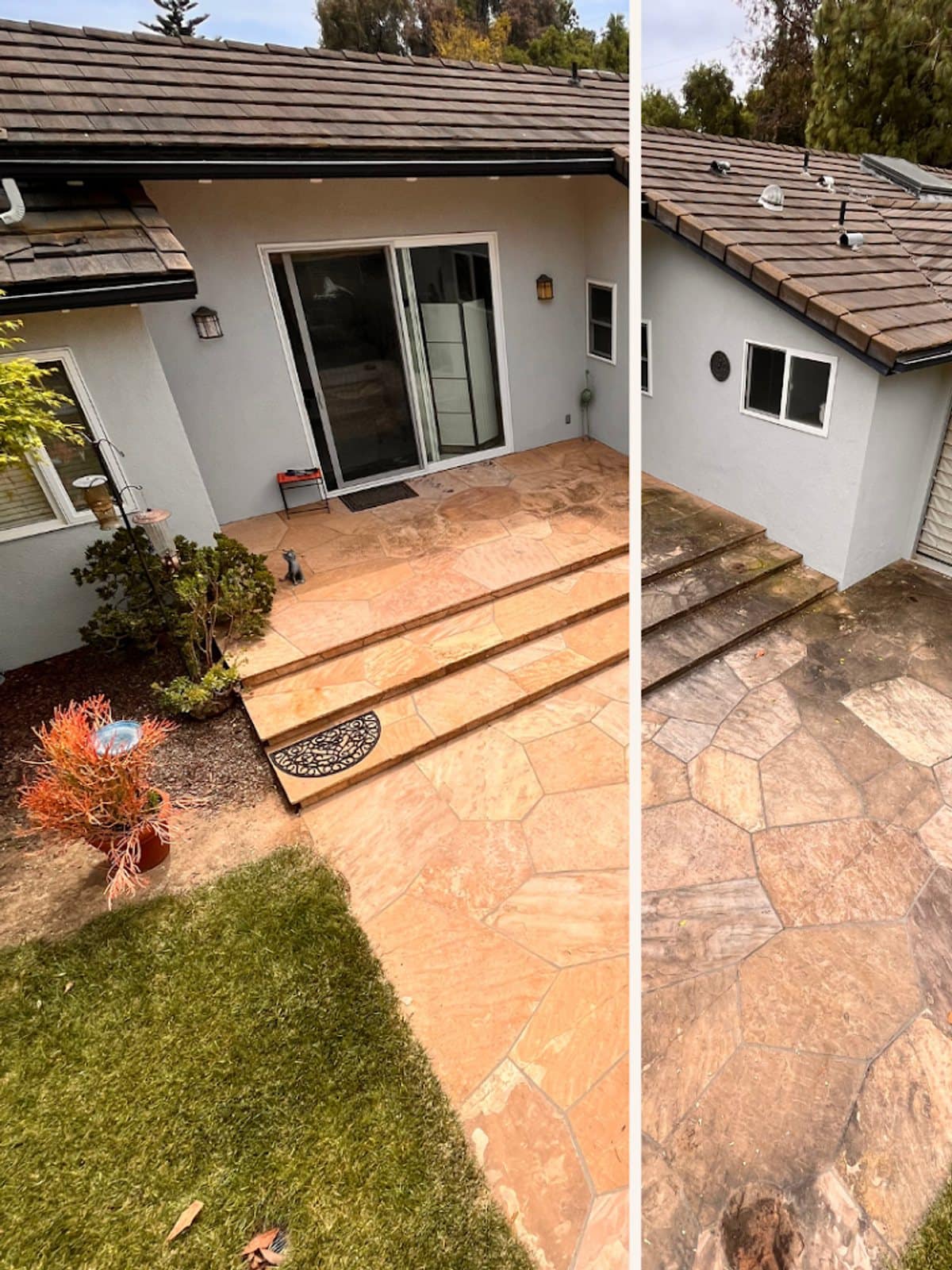
None of this means a rented pressure washer is useless. It is the right tool for exactly one category: hard, dense, ground-level surfaces. Your concrete driveway, a paver or stone patio, a brick walkway, and a concrete pool deck can all take real pressure, and force is genuinely the fastest way to lift the oil, tire marks, and dust they collect. That is the job the machine was built for.
Even there, technique matters. A plain wand leaves zebra stripes on concrete, the light-and-dark banding where passes overlap, and pre-treating oil with a degreaser before you blast is what actually lifts a set-in stain. But at least on concrete the worst case is an uneven clean, not structural damage. Point the same machine at the stucco or the roof and the worst case is a repair that costs more than every cleaning you will ever pay for.
The Goleta-Specific Trap
Here is the Goleta-specific trap that catches people. The problem you are trying to solve, that dingy green-black film on the north walls, the shaded fence, and the roof, is caused by the marine layer keeping those surfaces damp almost every morning. It looks like grime, so force feels like the answer. But it is living algae and mildew, and blasting it off the surface leaves the roots down in the pores of the stucco or the wood, so it grows back within a season while the surface is now damaged too.
The rental counter is not going to walk you through any of this. You get a machine, a couple of tips, and a pressure rating that is plenty to hurt the delicate surfaces on your house, with no guidance on which surfaces to keep it off. That is the gap that turns a hopeful Saturday into a callback. A soft wash kills the growth at the root so it stays clean for two to four years, which is the opposite of what a blast-and-regrow cycle gets you.
When to Just Call a Soft-Wash Pro
So if your weekend plan was one machine for the whole house, split it in your head: the driveway and hardscape can take a pressure washer, and the stucco, the wood, and the roof need a soft wash instead. Matching the method to the surface is the whole game, and it is the difference between a clean house and a repair bill.
Goleta Pressure Washing is a soft-wash specialist, owned and operated by Grant, and Goleta is home turf. We pressure wash the concrete that can take it and soft wash the stucco, wood, and roofs that can't, so every surface gets the right method, all across the Goleta-to-Summerland corridor. Before you load a machine into the truck that you might regret, call (805) 705-8914 for a free quote.