By Grant, owner-operator · June 16, 2026 · 7 min read
One Cause Sits Behind All of It
If you have wondered why your roof, your stucco, and even your solar panels all seem to grow a green-black film faster on the Central Coast than anywhere you have lived before, there is one answer behind all three: the marine layer. The same coastal fog that makes mornings gray from Goleta to Summerland is a growth engine for algae, mildew, and moss, and it treats your whole property as one big damp surface to colonize. Roof cleaning on the Central Coast is really a symptom of a bigger environmental fact, and once you see the math, the pattern on your house makes complete sense.
The short version: algae and mildew need moisture to grow, the marine layer delivers moisture almost every morning, and so everything it touches grows faster. Your roof, your walls, and your panels are not aging badly or poorly built. They are sitting in a climate that runs a growing season for algae essentially year-round.
The Marine-Layer Math
Here is the math. Algae and mildew do not need much to establish, just liquid water and time, and the marine layer supplies both on a schedule. Most mornings along the coast, a blanket of fog rolls in overnight and sits until mid-morning or later, laying down a film of moisture on every exterior surface and keeping the shaded ones damp for hours after the sun is up. Call it a few hours of usable dampness a day, most days of the year, and you have added up to an enormous amount of growing time.
Compare that to a dry inland climate, where a surface might be wet for a few hours after a rain a handful of times a year and bone dry the rest. The coastal surface gets more wet-hours in a month than the desert surface gets in a year. Growth rate follows wet-hours almost directly, so the same algae that's a non-issue inland becomes a constant, recurring film on the coast. That is the marine-layer math, and it applies to every surface on your property at once.
On Your Roof: Algae and Moss
On your roof, that math shows up as Gloeocapsa magma and moss. The blue-green algae feeds on the limestone filler in asphalt shingles and streaks the slopes dark; the moss packs into shaded valleys and the channels of clay barrel tile. Both concentrate on the north-facing slopes and the tree-shaded sections, exactly where the marine-layer moisture lingers longest, and both come back on that two-to-four-year coastal clock because the fog keeps feeding them.
The roof gets it worst because it is horizontal and it takes the full morning fog with nothing shading it from the damp, then holds that moisture on any slope the sun does not reach. This is why roof cleaning is such a constant need on the Central Coast specifically, and why it is almost always a soft-wash job: the growth is biological, fed by the climate, and the only thing that clears it without wrecking the roof is a solution that kills it at the root.
On Your Walls: The Green-Black Film
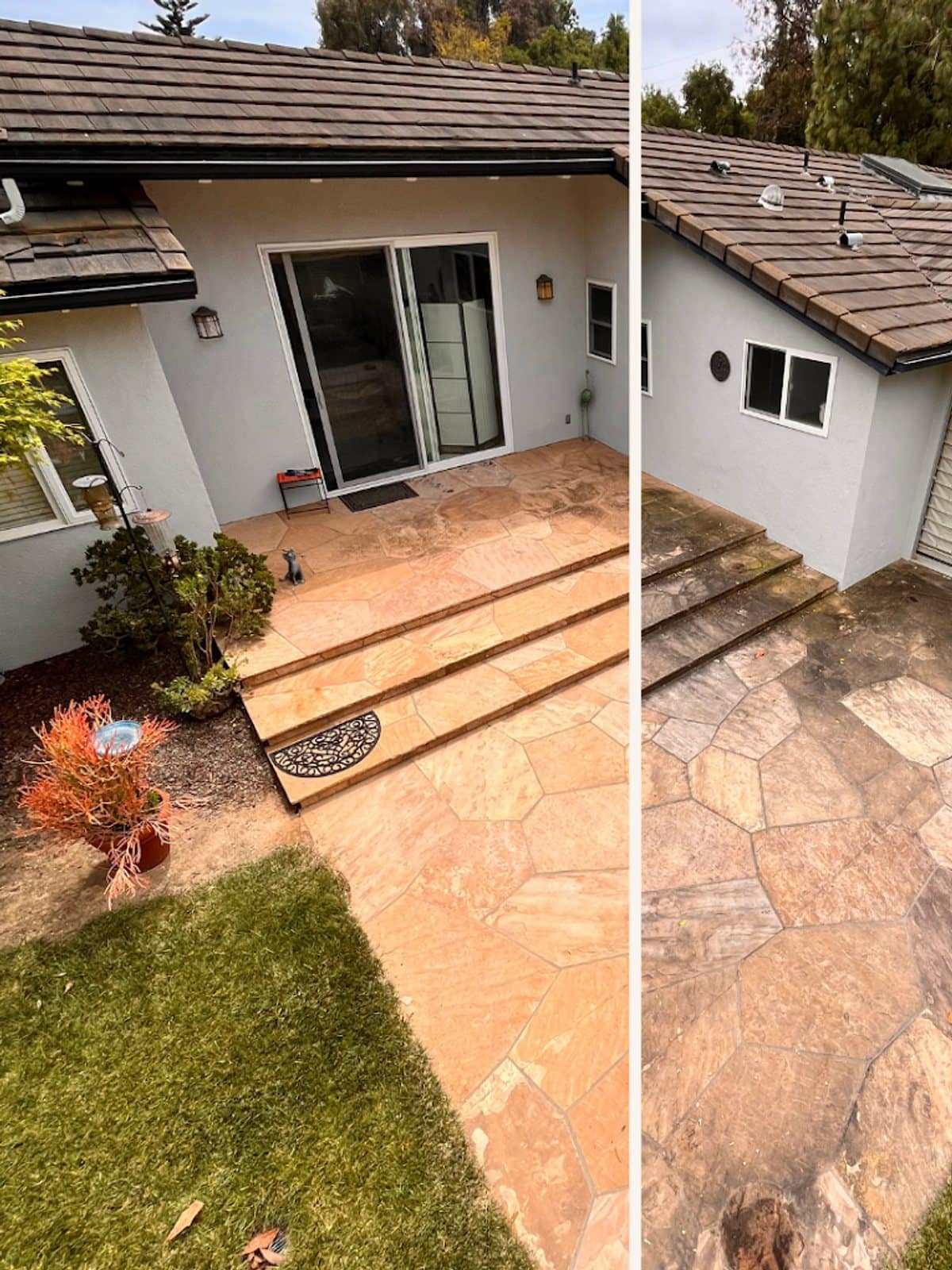
The same fog that streaks your roof films up your walls, and on a Santa Barbara stucco home it shows as a green-black haze on the north and shaded sides. Stucco is porous, so it holds the marine moisture and gives algae and mildew a rough, damp surface to root into, and the walls that get the least sun, the north face, the side under the eaves, the stretch behind a hedge, go dingy first while the sunny walls stay bright.
From the street that film reads as a tired, neglected house even when the paint underneath is perfectly sound. It is the wall version of the exact same problem on the roof, driven by the exact same marine-layer dampness, and it responds to the exact same method. A soft wash kills the growth in the pores of the stucco and rinses it clean, which is why house washing and roof cleaning on the coast are really two faces of one job.
The salt in the coastal air compounds the wall problem in a way pure inland dirt never does. Salt is hygroscopic, meaning it pulls and holds moisture out of the air, so a film of salt haze on a shaded stucco wall keeps that wall a little damper for a little longer than it would otherwise stay, which is one more nudge in favor of the algae. Homes closest to the water, along the Summerland bluffs, the Santa Barbara waterfront, and the ocean-facing sides of Montecito estates, carry the heaviest salt load and tend to film up fastest. It is the same story as the roof: the coast is not just humid, it is actively working to keep every surface damp enough to grow something.
On Your Solar Panels: Lost Output
Your solar panels are in on it too, and this one costs you money directly. The marine layer lays down a mineral and organic film on the glass, and the shaded edges of panels grow the same algae and mildew as everything else, especially where a panel frame traps a little moisture and grit. That film and edge-growth block light, and panels that are not producing at full output are quietly costing you the electricity you paid to generate.
Coastal solar arrays haze over faster than inland ones for the same reason the roof and walls do: more wet-hours, more deposited film, more growth. And like the roof, panels take a gentle touch, a soft, low-pressure clean that lifts the film without scratching the glass or forcing water into the seals. It is the same principle again: the marine layer put the growth there, and a careful low-pressure cleaning is what takes it off. Clean panels earn back the cost by producing what they are supposed to.
One Problem, One Method
Step back and the pattern is clear: roof, walls, and panels are not three separate maintenance problems, they are one environmental problem showing up on three surfaces. The marine layer supplies the moisture, the shaded and north-facing areas hold it longest, and algae and mildew grow on whatever is there, whether it is shingle, tile, stucco, or glass. The film on the north wall, the streaks on the north roof slope, and the haze on the panels are the same organisms fed by the same fog.
That is why one method handles all of it: soft washing. Low pressure plus a cleaning solution kills the growth at the root on every one of those surfaces without the damage that high pressure would do to any of them. The pressure washer that seems like the obvious tool is the wrong one on all three, stripping shingles, cracking tile, driving water behind stucco, and scratching panel glass. The coast grows the problem as one system, and soft washing solves it as one system.
Think About the Whole Property
The practical upshot is that it pays to think about your property as a whole rather than chasing each surface separately as it goes dingy. The roof, the stucco, and the panels are all on the same coastal clock, so cleaning them together, ideally in the fall before the winter rains, keeps the whole envelope clear through the season and usually makes more sense than a scattered surface-by-surface approach. When one part of the house has grown a film, the others are not far behind.
Goleta Pressure Washing is a soft-wash specialist, owned and operated by Grant, serving Goleta, Santa Barbara, Montecito, and Summerland on the Central Coast. We soft wash roofs, houses, and the delicate surfaces the marine layer films up, all with the low pressure they need, and because it's really one climate problem we can treat the whole property on a single visit. If the coast has filmed your roof and it's creeping onto the walls and the panels, call (805) 705-8914 for a free quote on all of it.