By Grant, owner-operator · June 12, 2026 · 7 min read
Same Soft Wash, Two Different Playbooks
Tile and composition roofs both get cleaned the same fundamental way, with a low-pressure soft wash, but the approach on each is different in the details that matter. The chemistry that kills the algae and moss is similar; how we move around the roof, how we protect it, and what we are guarding against are not. A contractor who cleans a brittle clay tile roof exactly the way they clean an asphalt shingle roof is guessing on at least one of them. So the honest answer to how we clean each is: same method, two different playbooks.
These are the two roofs we see across Santa Barbara, and knowing how each is handled tells you a lot about whether the person quoting your roof actually knows what they are doing. Let us take them one at a time, then cover what is identical on both.
The Two Roofs of Santa Barbara
Santa Barbara has two dominant roof types, and they could hardly be more different as materials. The first is clay or concrete barrel tile, the red Spanish tile that defines the look of the Riviera, Hope Ranch, Montecito, and most of the county's Mediterranean and Mission architecture. It is fired ceramic or cast concrete, heavy, brittle, long-lived, and built as a shield over a waterproof underlayment. The second is composition shingle, the standard asphalt shingle roof found on the county's mid-century tract homes, ranch houses, and newer construction, especially across Goleta.
The materials behave in opposite ways under a cleaning. Tile is hard and inflexible and cracks if you mishandle it, but its surface is not what keeps water out. Composition shingle is relatively soft and flexible, and its surface, the granule layer, is exactly what protects it. Those two facts drive everything about how each roof gets cleaned, which is why treating them the same is a mistake.
How We Clean Composition Shingle
On a composition shingle roof, the thing we are protecting above all is the granule layer. Those ceramic-coated granules are the shingle's sunscreen and its wear surface, and once they are gone the asphalt underneath dries out and fails early. So the entire approach is built around not disturbing them: a soft wash that kills the Gloeocapsa magma algae with a solution and rinses it away at low pressure, never scraping, never blasting, never taking granules off with the growth.
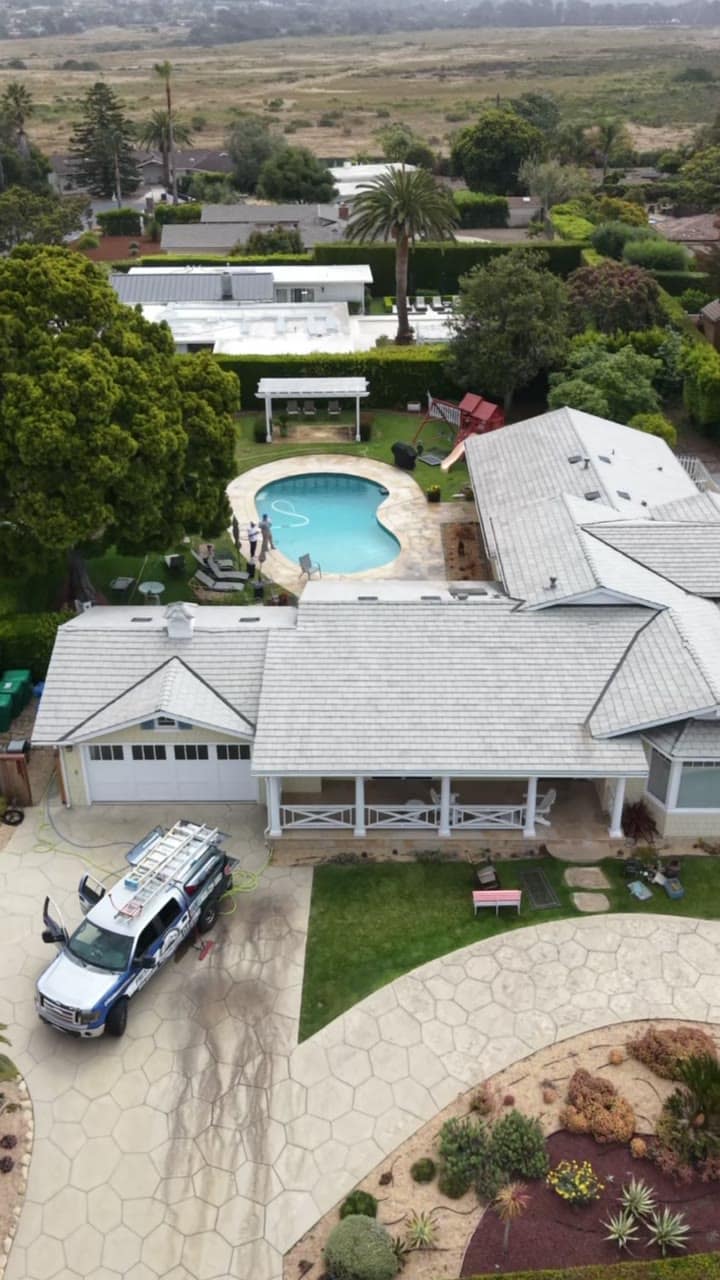
Shingle is walkable, more so than tile, but it still gets treated with care, especially on the steep pitches and the hot, brittle, sun-baked south slopes where an older shingle can be fragile. The algae on a shingle roof concentrates on the shaded north slopes, so that is where the treatment is heaviest. Done right, a shingle roof comes out clean and streak-free with every granule still in place, which is the whole point, because the alternative, a pressure wash, clears the algae by stripping the very layer that gives the shingle its life.
The age of the shingle changes how we dial the job, too. A newer architectural shingle in good shape is straightforward, but an older three-tab roof that has already shed granules and gone brittle in the sun needs an even gentler hand, because it has less life left to spend. We read the shingle before we treat it, because a fifteen-year-old composition roof on a Goleta ranch house is a different animal from a five-year-old one, even though both get the same low-pressure, granule-safe soft wash. Matching the touch to the condition is part of why soft washing is a craft and not just a setting on a machine.
How We Clean Clay and Concrete Tile
On a tile roof, the concerns flip. The granules are not the issue, because tile does not have them; the issues are that tile is brittle and that its waterproofing lives underneath it. So the playbook changes. First, walkability: clay and concrete tile cannot be freely walked, because stepping wrong cracks it, and old terracotta cracks easily, so we work carefully from the edges and ladders rather than tromping across the field of tile. A cracked tile is a future leak and an expensive, hard-to-match repair, so protecting the tile from our own feet is part of the job.
Second, water intrusion: because the underlayment beneath the tiles is the real waterproof layer, we keep the cleaning low-pressure so nothing drives water up under the tiles and past that membrane. The growth on tile packs into the overlaps and the curved channels of barrel tile, and a soft-wash solution flows into those channels and clears the moss where a pressure wand could only chip tile trying to reach it. Same soft-wash principle as the shingle roof, entirely different handling on the roof itself.
What's the Same on Both Roofs
For all those differences, the core of the job is identical on both roofs, and it comes down to three things. First, it is always a soft wash: low pressure, about the force of a garden hose, with a cleaning solution doing the actual work of killing the algae and moss at the root. Neither roof ever sees high pressure, because high pressure ruins both, stripping shingle granules and cracking tile while forcing water where it does not belong.
Second, both get the landscaping protected: pre-wetting and rinsing the plants around the house so the solution does no harm, which matters as much on a Goleta tract lot as on a Montecito estate. Third, both hold their results for the same two-to-four-year window, because killing the growth at the root, rather than knocking it off the surface, is what makes a cleaning last on the coast. The method and the chemistry are shared; only the footwork and the specific thing being guarded change from one roof to the other.
Why the Difference Matters When You Hire
This is worth understanding before you hire, because it is a quick way to tell a pro from a guesser. Ask how they will clean your specific roof. If you have tile and they talk about walking the roof and blasting the streaks, they're about to crack your tile and drive water under it. If you have composition shingle and they treat it like an indestructible surface, they're about to strip your granules. The right answer references your material and what it needs.
A contractor who only knows one method is going to apply it to both roofs, and one of those roofs will pay for it. Santa Barbara has both roof types on the same streets, sometimes on the same property, so the ability to switch approach by material is not a nice-to-have here, it is the baseline competence the job requires. The good news is that both are entirely cleanable, safely, with the same soft-wash foundation and the right handling on top.
Whichever Roof You Have, Book It Right
So whether your roof is red barrel tile or composition shingle, the cleaning is a soft wash, tuned to your material, done before the winter rains in the fall so the roof goes into the wet season clear. Tile gets the careful, off-the-tile, low-pressure handling that brittle clay and a hidden underlayment demand; shingle gets the granule-safe treatment that keeps its protective layer intact. Both come out clean, and both stay clean for years because the growth is killed at the root rather than scraped off.
Goleta Pressure Washing is a soft-wash specialist, owned and operated by Grant, and we clean both roof types across Santa Barbara, Goleta, Montecito, and Summerland every week. We match the approach to your roof, protect your landscaping, and never put high pressure on either surface, which is a good part of why the 63-plus reviews sit at a full five stars. Tile or composition, get a free quote at (805) 705-8914.