By Grant, owner-operator · May 22, 2026 · 8 min read
Wash It First, Then Decide on Paint
If your stucco looks tired and you are trying to decide whether to repaint it or just wash it, here is the money-saving answer: wash it first, then decide. A large share of the homes that look like they need painting are not faded at all, they are just covered in a film of algae, mildew, and coastal grime that a soft wash removes for a fraction of the price. You cannot always tell dirty from faded by eye, but there is a simple test that settles it, and the cost difference between the two answers is enormous.
The reason this matters is that repainting and washing are wildly different bills, and people routinely pay for the expensive one when the cheap one would have solved the problem. Before you get a single painting quote, it is worth five minutes to find out whether your stucco is genuinely faded or just dirty. Here is how to tell.
The Wet-Rag Test
The simplest way to tell dirty from faded is the wet-rag test, and you can do it yourself in a couple of minutes. Take a clean, damp white rag or sponge and firmly wipe a small patch of the dingy-looking stucco, ideally on a shaded wall where it looks worst. Then look at the rag and look at the wall. If the rag comes away dirty and the patch you wiped looks noticeably brighter and cleaner than the wall around it, your stucco is dirty, not faded, and a wash will bring the whole wall back.
If the rag stays relatively clean and the patch looks the same as the surrounding wall no matter how hard you wipe, then the color really has faded or chalked, and washing alone will not restore it. That is the case where paint is genuinely on the table. The test works because dirt and biological film lift onto the rag while true fade, which is a change in the paint itself, does not. One damp rag can save you thousands of dollars in unnecessary painting, or confirm that paint is actually warranted.
A related check is for chalking specifically. Rub your open hand across the dry stucco and look at your palm. If it comes away with a dusty, chalky residue the color of the paint, the finish is breaking down and chalking, which points toward repainting. A palm that stays clean, paired with a wet rag that lifts grime, is the clearest sign you are dealing with dirt and not a failed finish. Between the two quick tests, you can usually diagnose the wall without a professional even looking at it.
Dirty vs. Faded: What Each Looks Like
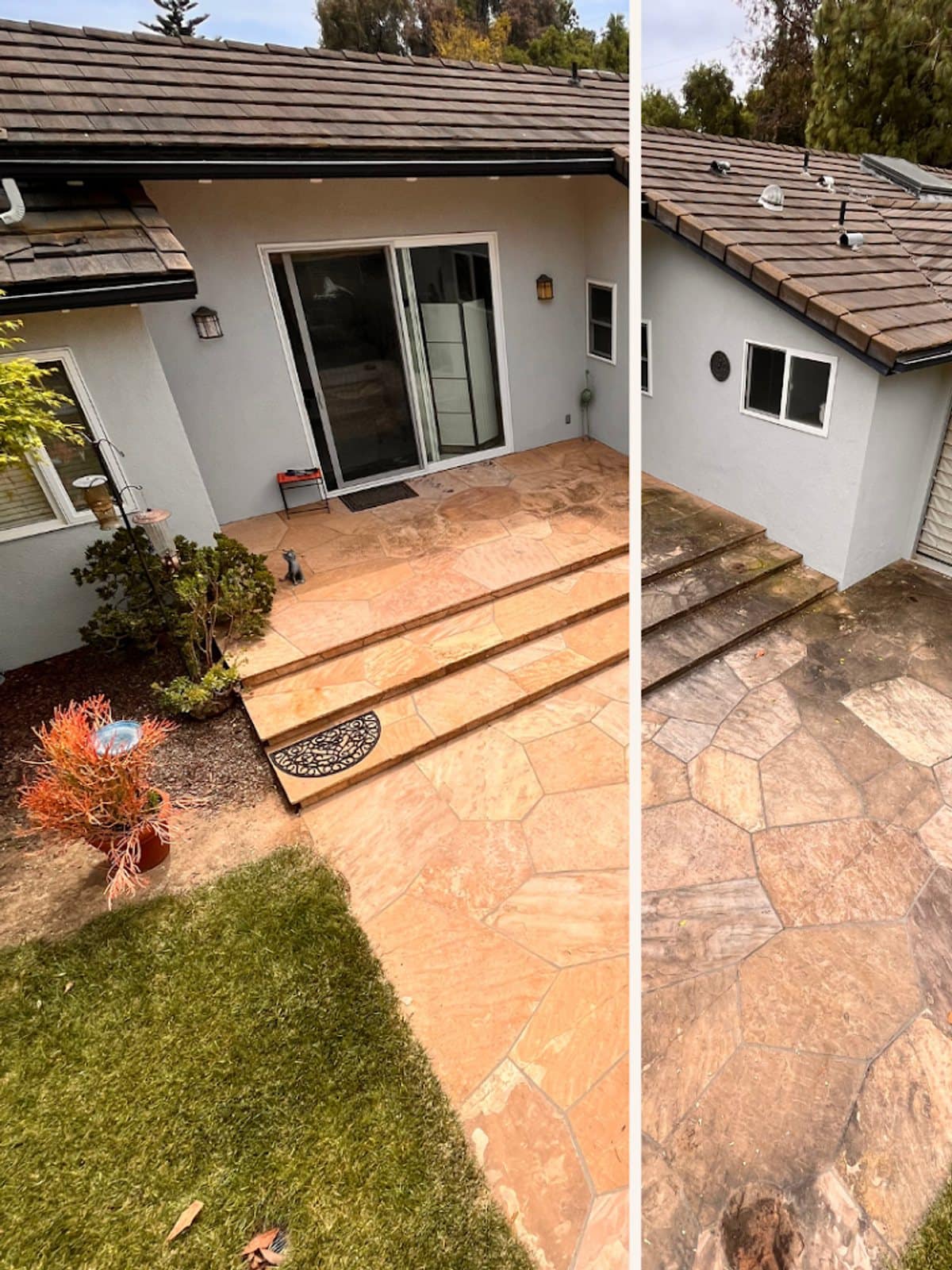
It helps to know what each condition actually looks like so the test confirms what you are seeing. Dirty stucco reads as a film: green-black streaking on the shaded and north-facing walls, dark runs below windows and roof lines, a general dinginess that is worse on some walls than others and worst where the sun does not reach. The unevenness is the tell, because biological growth follows moisture and shade, so it darkens the damp walls and leaves the sunny ones brighter.
Faded stucco reads as a change in the color itself: the paint looks washed out, lighter than it used to be, often fairly evenly across a whole sun-exposed wall, and it may look flat or powdery rather than filmy. True fade is usually worst on the sunniest walls, the south and west faces that take the most UV, which is the opposite pattern from biological film. So if your worst walls are the shaded ones, think dirt; if your worst walls are the sun-blasted ones and the color looks evenly bleached, think fade. The wet-rag test then confirms which it is.
The Cost Gap Is Huge
The reason all of this is worth checking is the cost gap between the two answers, which is large. A full house wash for most South Coast homes runs somewhere in the low hundreds to several hundred dollars depending on size and access. A full exterior repaint runs several thousand dollars and up, often many times the cost of a wash, once you count prep, materials, and labor. When the paint underneath is sound and the problem is just film on top, washing is the obvious call, and the savings are not small.
There is a protection angle on top of the cost. The algae and mildew growing on your stucco hold moisture against the finish and slowly break it down, so leaving the film up there actually shortens the life of the paint you already have. Washing removes what is degrading the surface, which is part of why a regularly washed house can go years longer between repaints. So a wash is not just cheaper than paint, it can push the next repaint further into the future, which saves you again down the line.
Why Coastal Stucco Looks Worse Than It Is
On the South Coast, this comes up constantly because the marine layer makes stucco look faded when it is really just filmed. The coastal fog keeps walls damp most mornings and feeds a steady film of algae and mildew, and that film dulls and grays the color in a way that genuinely mimics fading to the eye. Homeowners look at a hazy, dull wall, assume the paint is shot, and start pricing a repaint, when the actual problem is a living film the fog has been growing.
This is especially true on the shaded and north-facing walls and on homes near the water or under trees, which are exactly the walls that go dull first. Because the coast is so good at growing that film, a huge fraction of tired-looking South Coast stucco is dirty rather than faded. That makes the wet-rag test even more valuable here than it would be in a dry inland climate, because the odds that a wash solves your problem are simply higher on the coast.
When It Really Does Need Paint
Sometimes the honest answer is that it does need paint, and it is worth knowing those signs too, because a wash cannot fix them. If the wet-rag test comes back clean and the color is genuinely bleached, if your hand comes away chalky from the finish breaking down, if the paint is peeling, flaking, or blistering, or if there is cracking and damage that needs to be repaired and sealed, then you are past what washing can do and into repainting territory. A wash won't restore color that's actually faded or re-adhere paint that's failing.
Even then, washing usually still comes first, because you paint onto a clean surface, not over algae and grime. So the wall gets washed either way, and the question is only whether it also needs paint after. The point of the test is not to avoid painting when painting is warranted, it is to make sure you are not paying to repaint a wall whose only real problem was a film you could have washed off. Honest is honest in both directions.
Start With a Wash and Find Out
So the smart sequence is: run the wet-rag and chalk tests, and if the grime lifts and the finish is sound, wash the house and skip the repaint for now. If the color is truly faded or the finish is failing, wash it and plan to paint. Either way you start with a wash, and in a lot of cases the wash is the whole answer. It is the cheapest possible first move and it frequently makes the expensive move unnecessary.
Goleta Pressure Washing soft washes stucco homes across Santa Barbara, Goleta, Montecito, and Summerland, and we'll tell you honestly whether your wall is dirty or faded once we see it. You can read exactly how we think about pricing on our how-we-price page. We're insured, and before you pay to repaint, a wash is the cheap first move worth making. Call (805) 705-8914 for a free quote on one and find out if that's all it needs.