By Grant, owner-operator · June 24, 2026 · 8 min read
Hard Surfaces Get Pressure, Soft Surfaces Get Soft Washing
Concrete driveways, paver patios, brick walkways, and pool decks take pressure washing. Stucco walls, painted siding, wood, and roof shingles take soft washing. That single rule covers about 90% of the calls we run across Santa Barbara County's South Coast.
Pressure washing blasts a surface with water at 2,000 to 4,000 PSI. That force is exactly what a dense concrete slab needs to release ground-in oil, tire marks, and years of foot traffic. Soft washing runs under 500 PSI, closer to a garden hose, and leans on cleaning solution instead of raw force to break down mildew, algae, and dirt on surfaces that would crack, dent, or strip under real pressure.
So if the question is your driveway specifically, the answer is almost always pressure washing with a rotary surface cleaner. The exceptions are decorative stamped concrete with a fading sealer, or an old slab that's already spalling. Those we drop the pressure on and treat more carefully, which we'll get into below.
Why matching the method to the surface actually matters
Using the wrong tool is the number one reason we get called out to fix DIY damage. Somebody rents a 3,500 PSI machine for the driveway, then swings it over to the stucco or the garage door because it's right there, and now there's a gouged wall or a stripped panel that costs more to repair than the whole cleaning would have.
High pressure etches soft or aging concrete. Fresh, dense concrete handles a surface cleaner fine. But concrete poured before roughly 2010, or any slab that's started to spall, has a weaker surface layer. Hit it with a narrow 0-degree tip held too close and you'll carve visible lines and pockmarks into it. That damage is permanent. You can't un-etch concrete; you can only grind and reseal it, which runs several hundred dollars minimum.
On the soft side, the failures are worse because the surfaces are more expensive. High pressure forces water behind stucco and vinyl siding, where it feeds mold inside the wall. It strips paint and clear finishes off wood in a single pass. It cracks roof shingles and voids roof warranties, and most manufacturers explicitly say pressure washing a roof voids the coverage. Soft washing exists because these surfaces need chemistry doing the work, not force.
How we pre-treat oil and rust so they actually lift
Oil and rust don't come off with water alone, no matter how high you crank the pressure. Both have to be broken down chemically first, and skipping that step is why so many rented-machine driveways still show the same stains after an afternoon of blasting.
For motor oil, transmission fluid, and that dark shadow under where a car parks, we apply a degreaser and let it dwell. The solution pulls the oil up out of the concrete pores over 10 to 15 minutes, and then the surface cleaner lifts it off. Deep-set oil in a porous older slab sometimes takes a second application. It's the dwell time that does the work, not just the wash.
Rust is a different chemistry. Rust stains from a wrought-iron railing, a forgotten patio chair, or fertilizer overspray are iron oxide bonded into the concrete, and a degreaser won't touch them. Those need an oxalic or specialized rust remover applied directly to the stain. Done right, the stain lifts and rinses clean. Done with pressure alone, you'll spend an hour on it and it'll still be there when the slab dries.
Why a rotary surface cleaner beats a wand
A rotary surface cleaner is the flat, round attachment that spins two pressure jets under a housing and glides across the concrete. It's the single biggest reason a professional driveway looks even and a DIY one looks striped.
When you clean a driveway with a plain wand, you get what the trade calls zebra stripes or wand marks. Each pass cleans a narrow arc, and where the passes overlap or gap, you get lighter and darker bands baked into the finished slab. From the sidewalk it looks like somebody mowed the concrete. Those lines are hard to fix once they're there because you're chasing an even result across the whole surface.
The surface cleaner solves this by holding both jets at a fixed height and distance, spinning them so the whole path gets uniform contact. It cleans a wide, consistent strip every pass, so a two-car driveway comes out one even tone instead of a patchwork. It's also faster and it keeps the dirty water contained under the housing instead of spraying it across your garage door and up your neighbor's car.
How to tell which one your specific surface needs
The quick test: press your thumbnail into the surface. If it's hard and dense and won't dent, it can probably take pressure washing. If it's painted, sealed, soft, or up high where water could drive in behind it, it needs soft washing. When you're not sure, soft washing is the safer default because it won't cause damage even on a surface that could've handled more.
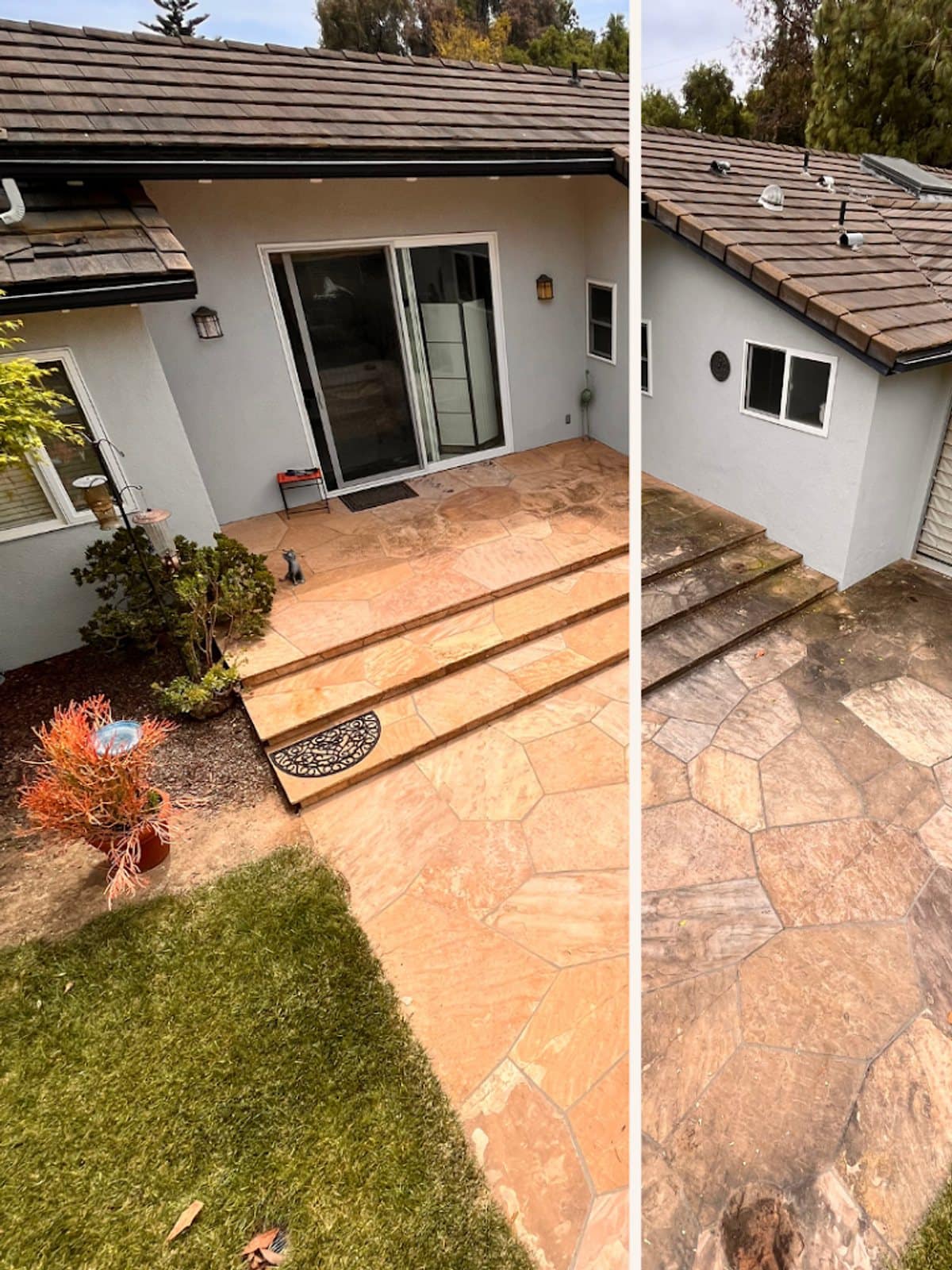
Pressure washing surfaces: concrete driveways, paver and stone patios, brick walkways, concrete pool decks, block retaining walls, and most hardscape. These are dense, ground-level, and built to take weather and traffic. A surface cleaner and the right pre-treatment get them clean without harm.
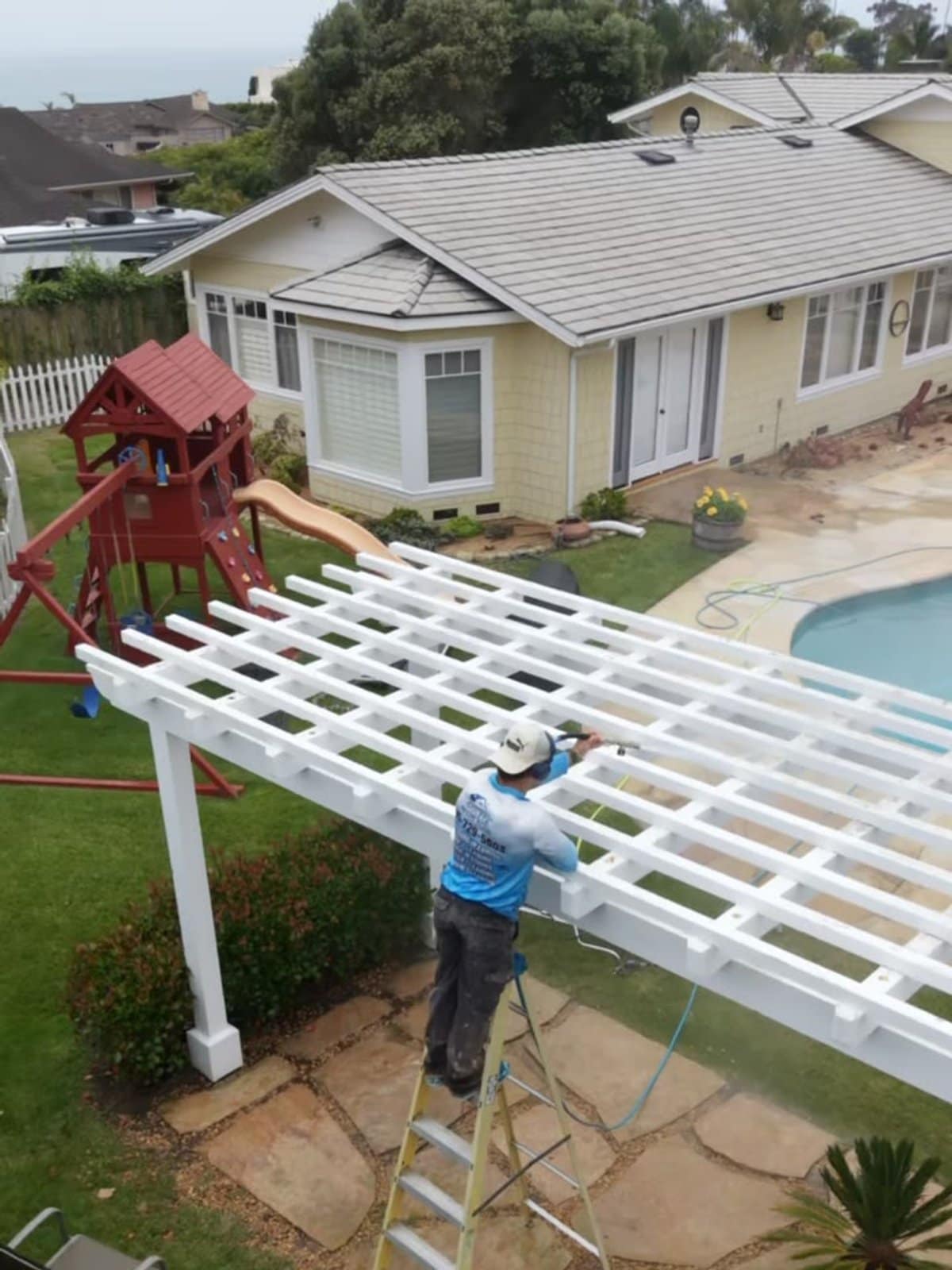
Soft washing surfaces: stucco, vinyl and fiber-cement siding, wood fences and decks, painted trim, screens, and anything on the roof including shingles, tile, and the gutters' exterior faces. If it's part of the building envelope or it's finished, it gets soft washed. Real houses are a mix, which is why we'll pressure wash the driveway and soft wash the stucco on the same visit, switching methods as we move around the property.
The South Coast angle: dry-season oil and coastal-damp mildew
The South Coast climate creates two specific driveway problems, and they call for the two different methods. Our long dry season, essentially May through October with almost no rain, bakes oil and grease deep into the concrete. Nothing rinses it out naturally the way a wet climate would, so it sets harder and darker every month. By the time most people notice, the stain needs a degreaser and a dwell, not just a rinse.
The coastal damp does the opposite job. Marine layer mornings in Goleta, along the Santa Barbara waterfront, and around Montecito and Summerland keep shaded concrete wet for hours after sunrise. That standing moisture feeds mildew, algae, and that green-black film on the north side of the house, under trees, and along fence lines that never see direct sun. Those growths are exactly what a low-pressure soft wash with the right solution is built to kill.
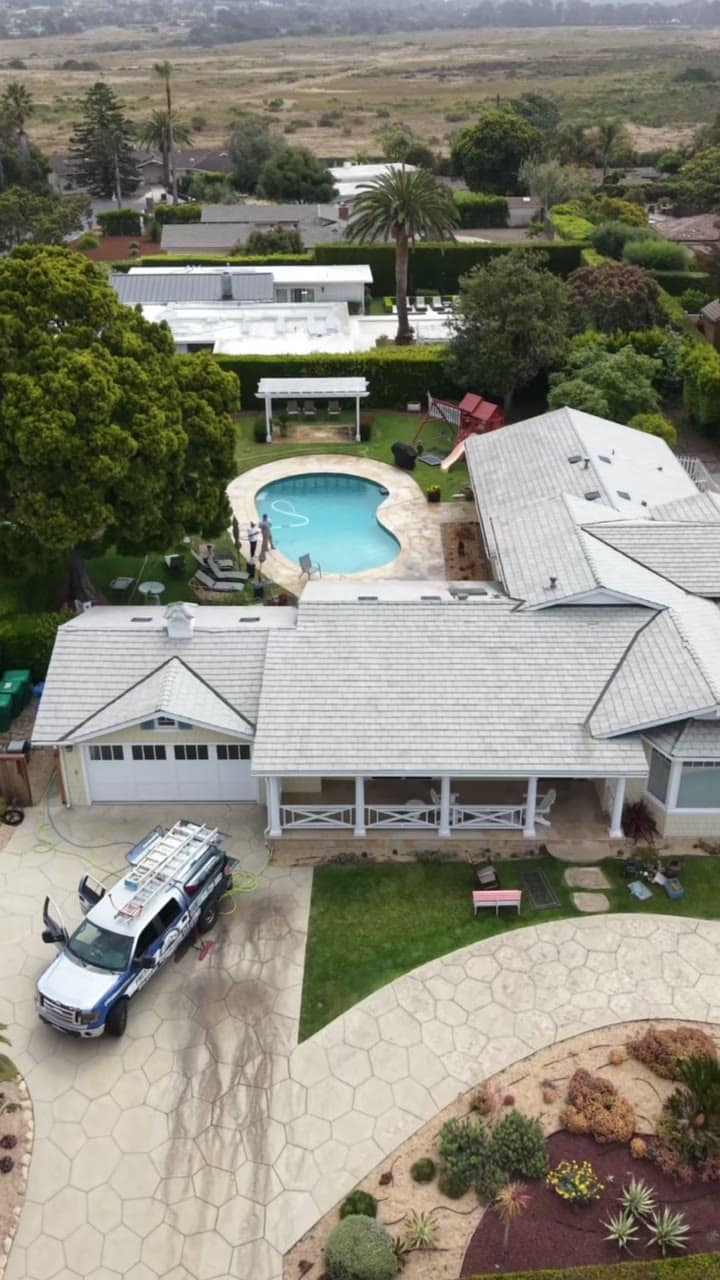
So a typical South Coast property genuinely needs both on one visit. The sunny stretch of driveway wants pressure washing to lift set-in oil. The shaded walkway, the stucco, and the north fence want soft washing to clear the mildew the marine layer keeps feeding. The farther you get from the water, the more of the baked-oil problem you see and the less of the coastal growth, but the same two-method approach applies.
How often to clean, and what drives the cost
About once a year keeps most South Coast driveways and exteriors looking right. Homes in heavy shade, under trees, or close to the coast where the marine layer sits often want a soft wash twice a year to stay ahead of the mildew, since it comes back faster in constant damp. A driveway that mainly collects oil and dust can usually go a full year between pressure washes.
Cost comes down to two things: square footage and staining. Square footage is straightforward, a bigger slab takes more time and more solution. Staining is what moves the number up: a driveway with heavy oil, rust, paint drips, or old dried mildew needs pre-treatment, dwell time, and sometimes a second pass, and that labor is where the price lives. A clean-ish slab that just needs a refresh costs less per square foot than one that's been neglected for five years.
A few other factors nudge the price: how far the water and dirt have to be managed near drains and landscaping, whether you want a sealer applied after on decorative concrete, and access, since a gated backyard patio takes longer to set up than an open driveway. We quote the specific surface and its condition rather than a flat rate, because a 600-square-foot driveway with one oil spot and a 600-square-foot driveway soaked in it are two different jobs.
The real risks of doing it yourself
The rental machine looks like a deal until you count what goes wrong. Etched concrete, stripped stucco, water driven behind siding, cracked roof shingles, gouged wood, and a stripe-marked driveway are all common DIY outcomes, and every one of them costs more to fix than hiring it done in the first place.
There's a safety side too. A pressure washer at 3,000 PSI can cut skin and cause a serious injection injury that sends people to the ER. The recoil off a hard surface throws grit and paint chips back at your face and eyes. On a ladder aimed at a second story, the kickback is genuinely dangerous, which is another reason roofs and high stucco should be soft washed from the ground by someone who does it daily.
Then there's the part nobody enjoys: renting the machine, buying the right degreaser and rust remover, guessing at pressure and tips, and burning a Saturday to get a striped, half-clean slab. We're insured, we bring the right tool for each surface, and we've cleaned driveways and exteriors all over the South Coast. If you'd rather have it done once and done right than gamble a Saturday on a rental, get a free quote at (805) 705-8914.