
By Goleta Pressure Washing · September 20, 2026
Avoid $150–$400 Window Cleaning Bills: Stop Sprinkler Spots on Home Windows
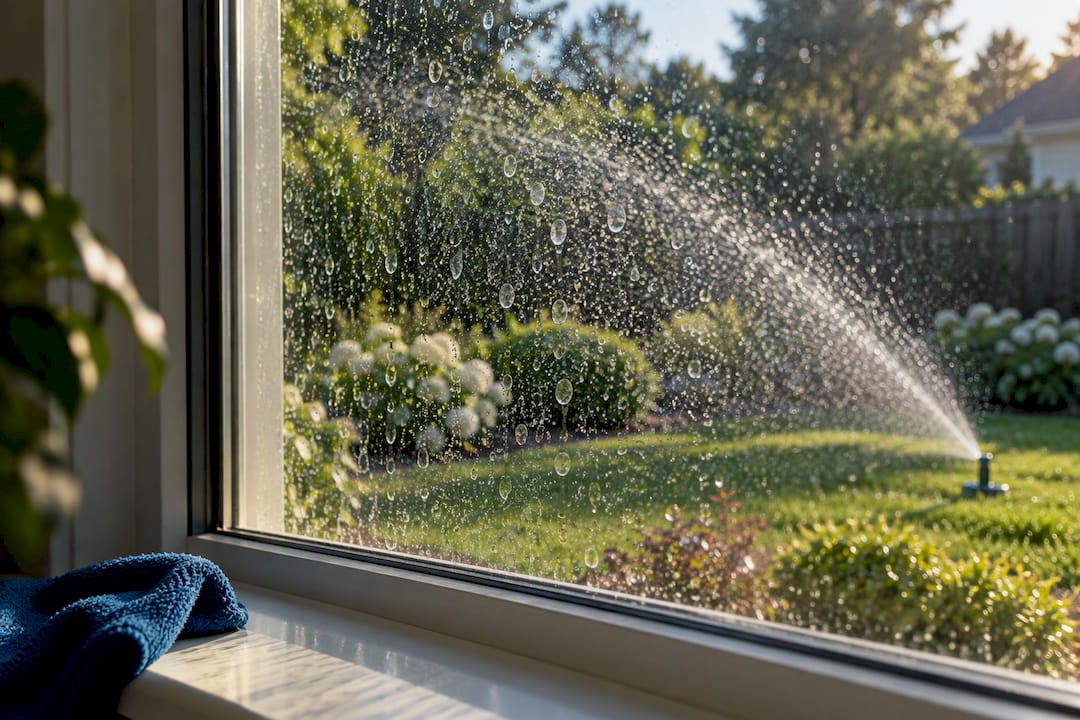
Fresh sprinkler mineral spots almost always come off with a weak acid like white vinegar, a thorough rinse, and an immediate squeegee dry. Deposits that have baked on for months or years may have etched the glass, which is often permanent and needs professional polishing or replacement. Either way, the fix that actually sticks starts outside, at the sprinkler head, not at the glass.
TL;DR:
- Fresh sprinkler water spots on windows can usually be removed with a vinegar and water solution, but stubborn or etched deposits require professional treatment.
- Water hardness from mineral-rich groundwater causes calcium carbonate buildup, which bonds into the glass over time and becomes difficult to clean.
- Correcting sprinkler head placement, pressure, and spray timing prevents new spots from forming, especially by avoiding watering during the hottest parts of the day.
- Tools like razor blades or abrasive pads can damage glass coatings and should be avoided; testing cleaners on small areas prevents permanent etching.
- Professional window cleaning is advisable for persistent spots, especially on hard-to-reach panes or when signs of glass etching appear.
Table of Contents
- Why Sprinkler Water Leaves Spots on Windows
- How Do You Remove Fresh Sprinkler Water Spots From Glass?
- When Are Water Spots Permanent Etching Instead of Removable Film?
- Preventing Sprinkler Water Spots Before They Start
- What Tools and Cleaners Should You Avoid on Windows?
- A Pro’s Take on Recurring Sprinkler Spots
- When to Call a Professional Window Cleaner
- Sources
- FAQ
Why Sprinkler Water Leaves Spots on Windows
Sprinkler water looks clean coming out of the nozzle, but it carries dissolved calcium and magnesium that never evaporate. The U.S. Geological Survey classifies water hardness by how much of these minerals it carries, and homes on well water or municipal supplies from mineral-rich groundwater often sit in the “hard” or “very hard” range without anyone realizing it.
Every time a droplet lands on glass and dries, the water disappears but the minerals stay behind as a thin film of calcium carbonate. One overspray event barely registers. Repeated overspray, day after day, builds layer on layer.
That layering is the real problem. Each wet-dry cycle bonds a little more tightly to the glass surface, and ordinary glass cleaner just pushes a streaky film around instead of dissolving it. A few things make this worse over a season:
- Direct sun baking droplets onto glass before they can run off
- Coastal humidity slowing evaporation just enough to concentrate minerals further
- Older galvanized or copper irrigation lines adding trace metals that darken the deposit
Left alone long enough, that film can start bonding into the glass surface itself rather than sitting on top of it, which is the point where cleaning stops working.
How Do You Remove Fresh Sprinkler Water Spots From Glass?
Fresh spots respond well to a simple acid-and-rinse routine, and you likely already have most of what you need under the sink.
Before you start: check whether your windows have a low-E coating or tint film. Coated glass can be more sensitive to acidic cleaners, so test any solution on a small, hidden corner first and watch for haze or discoloration after it dries.
What you’ll need:
- White vinegar (or a purpose-made mineral-deposit remover)
- Distilled water
- A spray bottle
- A soft, non-abrasive sponge or microfiber cloth
- A squeegee
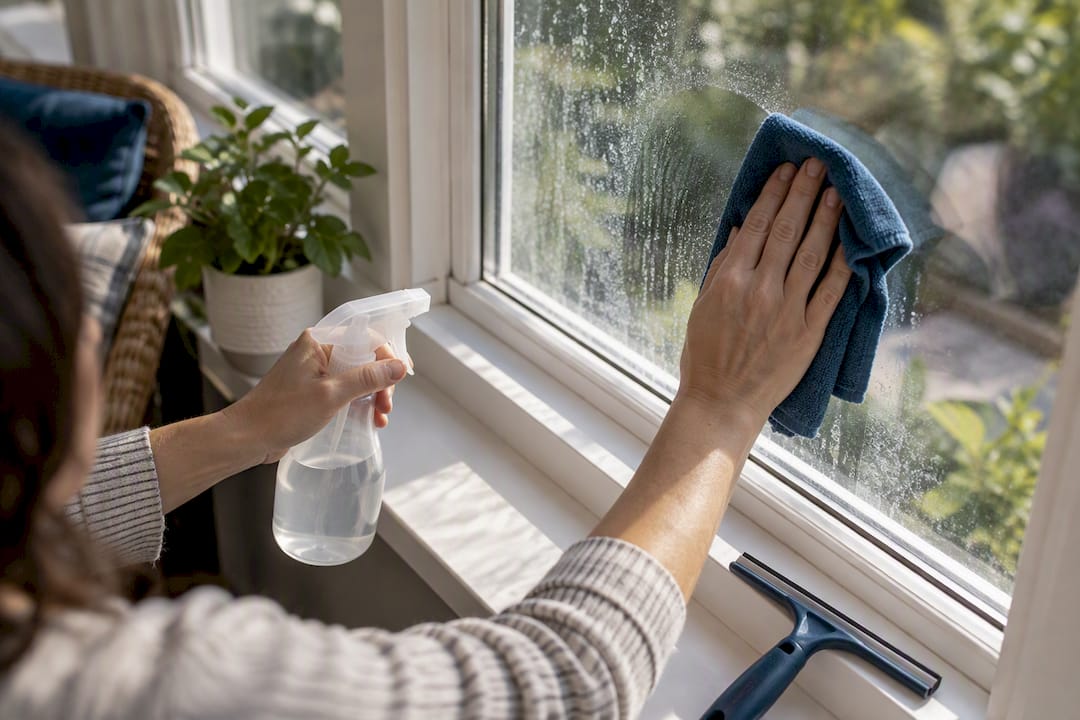
Then work through the glass in this order:
- Rinse first. Hose down the pane to remove loose dirt and grit so you’re not grinding debris into the glass during step three.
- Apply the acid. Mix equal parts white vinegar and distilled water in the spray bottle, or use a commercial mineral remover, and coat the spotted area evenly, according to University of Nebraska extension guidance on removing household mineral deposits.
- Let it dwell. Give the acid 5 to 10 minutes to break down the calcium carbonate. For crustier spots, a lint-free cloth soaked in full-strength vinegar and pressed flat against the glass under plastic wrap for 10 to 15 minutes gives the acid more contact time before you agitate it.
- Agitate gently. Wipe with the soft sponge in small circles. Do not scrub hard or press a scraper into the glass.
- Rinse thoroughly. Flush every trace of vinegar off the glass and the frame around it.
- Squeegee and dry immediately. Standing water left to air-dry just starts the mineral cycle over again.
Rinse promptly around window frames, especially near painted trim or stucco, since prolonged acid contact can dull paint or etch soft masonry.
Pro Tip: Work one pane at a time in the shade if you can. Vinegar solution that dries on the glass before you rinse it just adds another mineral layer to the one you’re trying to remove.
When Are Water Spots Permanent Etching Instead of Removable Film?
Not every stubborn spot responds to vinegar, and that’s usually a sign you’re dealing with etching rather than surface film. Etching happens when mineral deposits sit long enough that they start eating into the glass itself rather than resting on top of it, according to GlassRenu’s technical reference on hard water damage.
A few checks tell you which one you’re facing:
- The vinegar test: apply the acid solution, let it dwell the full 10 minutes, and rinse. If the spot fades noticeably, it’s film. If it looks the same, you’re likely looking at etching.
- The fingernail test: run a nail gently across the dry spot. Film feels slightly rough but even. Etching often feels like a shallow, permanent texture change you can’t smooth out.
- The light test: angle a flashlight across the pane. Etching frequently shows as a cloudy, mottled pattern that doesn’t shift with cleaning.
Etching is often partially or fully irreversible, and no amount of scrubbing brings the glass back to its original clarity. Restoration specialists can sometimes polish out light to moderate etching using compounds designed for glass surface restoration, but deep etching typically means replacement is the only real fix. If vinegar doesn’t budge a spot, don’t reach for something stronger on your own. Get a professional opinion before you decide between polishing and replacing the pane.
Preventing Sprinkler Water Spots Before They Start
Cleaning off spots without touching the sprinkler system just buys you a few weeks before they’re back. The USGS notes that adjusting irrigation so that hard water never reaches the glass in the first place is the most effective long-term fix.
Start with the hardware itself:
- Redirect the arc. Most rotor and spray heads let you adjust the arc pattern and throw radius with a small screwdriver or a dial on top of the head.
- Lower the pressure. Overpressurized heads mist rather than spray, and mist drifts further onto siding and windows than a controlled stream does.
- Swap nozzles near the house. Foundation-adjacent zones often do better on drip line or low-angle bubblers instead of standard spray heads.
- Add a physical barrier. Dense shrubs or a low hedge between the sprinkler zone and the window can intercept overspray before it ever hits the glass.
Timing matters almost as much as aim. Watering early in the morning, before direct sun hits the glass, gives droplets a chance to run off or evaporate slowly instead of baking on. Midday watering under full sun is close to the worst-case scenario for spotting.
If you’ve corrected head placement and pressure and spots keep showing up, the water itself may be unusually hard. It’s worth having your water tested or asking an irrigation professional to look at your system’s pressure and layout.
Pro Tip: Run your sprinklers during daylight once and photograph where the spray actually lands. Most people are surprised to see a head throwing three feet further than they thought, right onto a window they’d never suspected.
What Tools and Cleaners Should You Avoid on Windows?
The tools that feel like they’d work faster are usually the ones that cause permanent damage. FGIA’s homeowner care guidance is direct about this: pressure washers, razor blades, steel wool, and abrasive scouring pads can all scratch glass, damage seals, or strip protective coatings.
Keep these rules in mind before you touch the glass:
- Test any cleaner in a small hidden spot first, especially on coated or tinted glass.
- Avoid washing windows in direct, hot sun, since the solution dries too fast to do its job.
- Rinse thoroughly and dry immediately with a squeegee rather than letting water air-dry.
- Wear gloves when working with vinegar or commercial mineral removers for any length of time.
A Pro’s Take on Recurring Sprinkler Spots
Most repeat spotting traces back to a sprinkler head nobody’s looked at in years, not a cleaning technique that’s failing. Running your system once during the day and watching where the spray actually lands catches misaligned heads that a nighttime or early-morning cycle hides completely.
A five-minute monthly check, looking at head alignment and watching for slow leaks around the base, prevents far more repeat cleanings than any cleaning product does. In coastal areas with consistently hard water, building a seasonal rinse into your routine, even without full mineral buildup, keeps deposits from ever getting the chance to layer up.
— Grant K.
When to Call a Professional Window Cleaner
Some situations call for a professional rather than another weekend with vinegar and a squeegee. Visible etching, second-story or hard-to-reach panes, and spots that keep coming back even after you’ve fixed your sprinkler heads are all good reasons to bring in help.

A professional cleaning crew brings the same low-pressure approach that protects delicate surfaces, paired with specialist mineral removers formulated for exactly this kind of buildup rather than a household vinegar mix stretched past its limits. Some window cleaning services cover exterior glass, screens, tracks, and sills, and if a pane turns out to be etched rather than filmed, the crew that quotes the job can point you toward restoration options instead of guessing with stronger chemicals. Pricing for window cleaning runs $150 to $400 per job depending on the size and access of the property, and the crew that gives the quote is the same one that shows up to do the work.
If you’re not sure what a cleaning would run for your home, the window cleaning cost calculator gives you a quick estimate before you commit. Get a quote today and let someone else handle the ladder work.
Sources
- Hardness of Water | U.S. Geological Survey
- NF93-134 Water Nuisances: Alternatives to Cleaning Deposits on Household Surfaces | University of Nebraska extension
- Maximize Window, Door & Skylight Lifespan | FGIA
- How To: Remove Hard Water Etching from Glass - GlassRenu
FAQ
How Do You Get Sprinkler Water Spots Off Windows?
Spray a mix of equal parts white vinegar and distilled water on the spotted glass, let it sit for 5 to 10 minutes, then agitate gently with a soft sponge before rinsing thoroughly. Dry immediately with a squeegee, since air-drying just starts a new mineral layer forming, according to University of Nebraska extension guidance.
How Do You Keep Windows From Water Spotting?
Adjust your sprinkler heads so the spray arc and pressure never reach the glass, since USGS guidance points to irrigation correction as the most effective long-term prevention. Watering early in the morning instead of under direct sun also helps, since droplets get more time to run off before they bake onto the pane.
Will Dawn Dish Soap Remove Water Spots?
Dish soap can lift dirt and grease, but it does little against mineral deposits, since calcium carbonate needs an acid to break down. A weak acid like white vinegar or a purpose-made mineral remover works far better on actual hard-water film.
Can Water Spots on Glass Be Permanent?
Yes, if mineral deposits sit long enough they can etch into the glass surface rather than just coating it, and that damage is often partially or fully irreversible according to GlassRenu. Light etching sometimes responds to professional polishing, but deep etching usually means the pane needs replacing.
When Should You Hire a Professional Instead of Cleaning Yourself?
Call a professional if you see cloudy, textured spots that don’t respond to a vinegar test, if the windows are hard to reach safely, or if spots keep returning after you’ve fixed the sprinkler heads. Goleta Pressure Washing’s window cleaning service handles exterior glass with low-pressure methods built for exactly this kind of mineral buildup.
Recommended
Ready for a quote?
Roof cleaning, house washing, and pressure washing across Goleta, Santa Barbara, Montecito & Summerland.
Get a fast quote →