By Goleta Pressure Washing · October 3, 2026
Avoid Fines: Santa Barbara Pressure Washing Checklist for Homeowners

You can have your home pressure or soft washed in Santa Barbara, but only if all wash water is contained and disposed of legally. Discharging wash water to streets, gutters, or storm drains is prohibited and enforced under Title 16 of the municipal code. We built our own containment practices around this rule, which is why we can say with confidence that compliant cleaning is entirely possible here.
TL;DR:
- Containment measures such as berms, drain covers, and vacuum recovery are mandatory to prevent wash water from reaching storm drains or waterways.
- Most residential jobs do not require permits if wash water is properly contained, hauled, or routed to approved disposal points; permits are mainly needed for high-volume or sewer-connected discharges.
- The city enforces pollution rules actively, escalating from warnings to fines, with daily penalties possible for repeated violations or unresolved issues.
- Collected wash water must be directed to the sanitary sewer with permission or onto a percolating landscape area, never onto streets, gutters, or storm drains.
- Using soft washing reduces runoff and surface damage, making compliance easier and protecting older or historic homes from high-pressure damage.
Table of Contents
- Santa Barbara rules at a glance: Title 16, Creeks Division enforcement, and fines
- Best management practices contractors must use
- Where collected wash water can legally go
- When a discharge permit actually applies
- What to verify before you hire a crew
- Why soft washing fits coastal Santa Barbara homes
- Seasonal timing affects more than scheduling
- How fines scale with repeated violations
- What counts as an authorized discharge area
- A local provider’s perspective on staying compliant and protecting Santa Barbara homes
- How we help Santa Barbara homeowners stay on the right side of these rules
- FAQ
- Sources
Santa Barbara rules at a glance: Title 16, Creeks Division enforcement, and fines
The city treats wash water the same way it treats paint rinse or motor oil: as a pollutant that cannot legally reach a storm drain, gutter, or creek. Title 16 prohibits any non-storm water discharge into the municipal storm drain system, and the Creeks Division is the office that enforces it. That matters because Santa Barbara’s storm drains flow directly to the ocean with no treatment step in between, so a soapy rinse from a driveway can reach Leadbetter Beach within hours.
Enforcement generally follows a pattern: an inspector documents the discharge, issues a notice with a cleanup deadline, and escalates to fines if the runoff continues or reappears.
- A first observed violation typically brings a warning and a correction deadline.
- A missed deadline or repeat offense brings a monetary fine.
- Continued noncompliance can bring daily fines until the property is back in compliance.
Enforcement is active and specific: the city’s pollution enforcement page confirms penalties escalate from warnings to fines, with daily fines possible for repeat or unresolved violations. That escalation is exactly why we treat containment as a planning step, not an afterthought.
Best management practices contractors must use
The city does not ask contractors to guess at compliance. The Runoff Controls handout spells out the containment measures expected on any job that produces wash water: berms or sandbags to box in the work area, drain covers over nearby storm inlets, and a vacuum or sump system to pull water off the surface before it can travel.
Dry cleanup matters just as much as the wet work. Sweeping debris and sediment before rinsing, rather than hosing it toward the street, cuts the volume of contaminated water a crew has to manage. The handout is specific that collected wash water cannot simply be released once it is contained; it has to be filtered, settled, or routed to an approved disposal point.
In practice, a compliant job looks like this: lay down containment at the lowest point of the work area, cover any storm drain inlet within reach of the runoff, wash in sections rather than flooding the whole surface at once, and vacuum or squeegee the water into a holding tank as you go. Crews that skip this sequence are not cutting a corner. They are creating the exact violation Title 16 was written to stop, and the property owner can end up holding part of that liability.

Where collected wash water can legally go
Containing the water is only half the job. Santa Barbara and neighboring Goleta both require that collected wash water end up somewhere other than the ground or a drain, and the options are narrower than most homeowners expect.
Goleta’s guidance for mobile cleaning operations lays out the two accepted paths. The first is discharge to the sanitary sewer, but only with permission, since sanitary sewer connections are typically inside the home and not something a crew can tap into from the driveway without coordination. The second is release onto a landscaped area capable of absorbing the water through percolation, and even that option requires checking local rules first, since some soils and some properties near creeks are not suitable.
For most residential jobs, the realistic answer is that a contractor hauls the collected water away for disposal rather than releasing it on site. If a job does call for sanitary sewer discharge, the local sanitary district is the office to contact before work begins, not after. Homeowners who want to verify a contractor’s plan can ask a simple question: where is the wash water going once it is collected? A vague answer is a warning sign.
When a discharge permit actually applies
Most residential soft-wash and pressure-washing jobs, roofs, siding, driveways, do not require a standalone permit, because the water is contained and hauled or routed to an approved point rather than discharged on site. Permits become relevant when a job involves a connection to the sanitary sewer system or a higher-volume commercial discharge, since Title 16 establishes conditions under which a wastewater discharge permit applies.
The practical rule for homeowners: if your contractor’s plan involves anything beyond containment, vacuum recovery, and hauling, ask whether a permit is needed and who is pulling it. For a typical house wash or roof clean, the answer is usually none, because the water never leaves the property until it is in a tank. For larger properties, HOAs, or jobs that involve washing shared parking areas or commercial lots, it is worth a call to the city’s public works office to confirm before the crew shows up. When in doubt, the Creeks Division contact listed on the city’s pollution page is the right first call.
What to verify before you hire a crew
A license and an insurance certificate tell you a contractor is operating legally, but neither one tells you whether they know how to keep wash water out of the storm drain. Both pieces matter, and homeowners and property managers should ask for them before a crew arrives, not after a notice shows up from the city.
- Ask for a current CSLB contractor license number and confirm it is active.
- Request proof of liability insurance, since you can be held partly responsible if uncontained runoff from a job on your property reaches a storm drain.
- Ask for a written containment and discharge plan describing where the wash water will go.
- Confirm whether the crew will use berms, drain covers, or vacuum recovery on your specific property layout.
That written plan is the detail most homeowners skip, and it is the one that matters most. A contractor who has one ready, without being pushed for it, has usually done this kind of job before. One who has never heard the question is a risk you are taking on along with them.
Why soft washing fits coastal Santa Barbara homes
High-pressure washing and soft washing solve the same visible problem, dark streaks, moss, and algae on a roof or siding, but they get there differently, and the difference matters more here than in drier inland towns. Santa Barbara’s marine layer keeps roofs and north-facing walls damp for hours after sunrise most mornings, which is exactly the environment algae and moss need to take hold. Soft washing uses low pressure paired with a cleaning solution to kill that growth at the root, rather than blasting it off the surface.
That lower pressure is not just gentler on asphalt shingles and old stucco, it is also easier to contain. A high-pressure rinse throws water outward in a wide, fast spray that is hard to corral behind a berm. A soft wash applies less volume at lower force, which means less runoff to manage and a smaller margin for error if containment slips for a moment. On the many older and historic homes scattered through downtown Santa Barbara and Montecito, that gentler approach also protects original materials that high pressure can strip or crack. The compliance benefit and the surface-protection benefit are, in practice, the same decision.
Seasonal timing affects more than scheduling
Santa Barbara’s rainy season, roughly November through March, changes the calculus for any exterior cleaning job. Wet ground and saturated soil reduce how much water a landscaped area can absorb through percolation, which narrows the already limited disposal options described in Goleta’s mobile cleaning guidance. A contractor planning to release contained wash water onto a landscaped area in January is working with far less margin than one doing the same job in August.

Rain itself is also a factor during the job, not just after it. Washing during or right before a storm increases the odds that runoff mixes with stormwater and travels further than a contained job would in dry weather. Most experienced crews avoid scheduling exterior cleaning around forecasted rain for this reason, and it is a reasonable question to ask a contractor before booking a winter appointment.
Dry summer months bring a different consideration: algae and moss growth tends to peak after the wet season ends, so spring is often when Santa Barbara homeowners notice the most buildup and book the most cleanings. That timing works in homeowners’ favor, since drier ground gives contractors more reliable disposal options to work with.
How fines scale with repeated violations
The pattern the Creeks Division follows is designed to give property owners a chance to correct a problem before it becomes expensive. A first violation typically results in a warning and a deadline to fix the issue, not an immediate fine. The city’s enforcement page confirms that penalties escalate from that initial warning to monetary fines, and that daily fines are possible when a violation is repeated or left uncorrected past the deadline.
That structure means the real financial risk is not a single accidental overspray, it is ignoring a notice or hiring the same noncompliant contractor twice. A property manager overseeing multiple units carries a higher version of this risk, since a pattern of violations across several addresses draws more attention than an isolated incident. The safest position is treating any notice from the Creeks Division as something to resolve immediately, with documentation, rather than something to dispute or delay.
What counts as an authorized discharge area
Santa Barbara’s rules draw a clear line between water that is allowed to leave a property and water that is not. An authorized discharge area is a location where water has been specifically approved to go: the sanitary sewer, with permission, or a landscaped area confirmed to absorb water through percolation without running off toward a street or drain. Both paths require the kind of coordination described in Goleta’s mobile cleaning guidance, not a default assumption that any patch of grass qualifies.
An unauthorized discharge area is everything else that wash water can reach if it is not contained: the street, a gutter, a storm drain inlet, a driveway slope that feeds toward a public right of way, or a creek. The city’s runoff controls handout is direct on this point: wash water shall not reach storm drains or watercourses, full stop, regardless of how diluted or how biodegradable the cleaning product claims to be. That last detail surprises a lot of homeowners who assume an eco-friendly label changes the rule. It does not.
A local provider’s perspective on staying compliant and protecting Santa Barbara homes
We plan every job around containment first, because a soft wash that strips algae but leaves runoff in the gutter has not solved the actual problem. Our crews bring a written discharge plan, recover wash water by vacuum, and coordinate sanitary sewer disposal when a job calls for it. If you ever suspect uncontained discharge nearby, the Creeks Division hotline is worth the call.
— Grant K.
How we help Santa Barbara homeowners stay on the right side of these rules
We built our process around the containment and disposal rules covered above, so you do not have to manage compliance yourself while we’re on your roof or driveway. Every job starts with a written containment plan specific to your property, and our soft-washing method means less water volume to manage in the first place, which lowers the risk of runoff compared with a straight high-pressure rinse.

- Roof cleaning for algae and moss on asphalt shingles, with pricing varying by job size and conditions.
- House washing for siding and stucco, with pricing varying by job size and conditions.
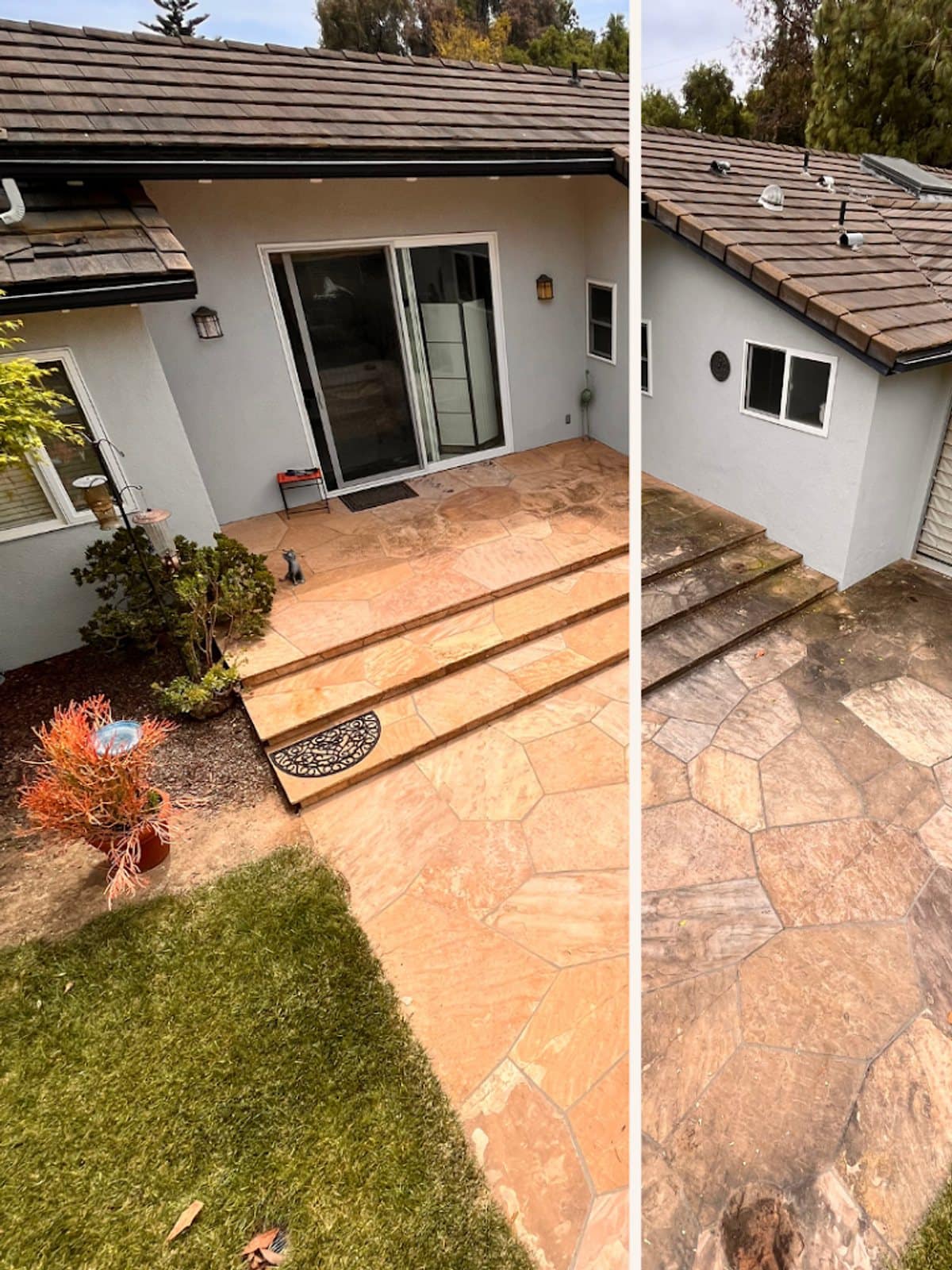
- Pressure washing for driveways and concrete, quoted on request.
If you want a compliant clean without tracking the rules yourself, get a quote for roof or house washing and we’ll handle the containment plan from there.
FAQ
Is pressure washing legal in Santa Barbara?
Yes, pressure washing and soft washing are legal in Santa Barbara as long as the wash water is contained and disposed of properly rather than released into a storm drain, gutter, or street. Title 16 is the code section that governs this, and the Creeks Division enforces it.
What happens if wash water reaches a storm drain?
The Creeks Division typically issues a warning with a correction deadline for a first violation, and escalates to monetary fines, including possible daily fines, if the problem continues or recurs, according to the city’s pollution enforcement page. Property owners can share liability with a contractor if uncontained runoff from a job on their property causes the violation.
Do I need a permit to pressure wash my house?
Most residential jobs do not require a standalone permit, since the water is contained and hauled or routed to an approved disposal point rather than released on site. A permit becomes relevant mainly for sanitary sewer connections or higher-volume discharges, which Title 16 addresses directly.
Where can collected wash water legally go?
Collected wash water can go to the sanitary sewer with permission, or to a landscaped area confirmed able to absorb it through percolation, per Goleta’s mobile cleaning guidance. It cannot be released onto a street, driveway slope, or anywhere that drains toward a storm inlet or creek.
How much does house washing cost in Santa Barbara?
Goleta Pressure Washing prices house washing between $250 and $500 per job, and roof cleaning between $350 and $900 per job, depending on size and condition.
Sources
Recommended
Ready for a quote?
Roof cleaning, house washing, and pressure washing across Goleta, Santa Barbara, Montecito & Summerland.
Get a fast quote →